Showing posts with label Manufacturing Consent. Show all posts
Showing posts with label Manufacturing Consent. Show all posts
Thursday, May 20, 2010
Blog 11: The Yes Men
The "Yes Men" documentary, or mockumentary details events that they set up to fool and satirize public knowledge. They use mass media such as public news and private functions such as investor meetings to get their points across. They prey on the fact that people listen to the news and take the knowledge it conveys as true to the letter. Also, it shows that news is full of bias as the events that led to their impersonation of Dow/Union Carbide brought back news that viewers were not aware of. People did not know that the problems are not solved over at Bhopal. It would appear that corporate America does a fantastic job of containing news and controlling mass media, despite the fact that certain truths are filtered by medial bias. What I enjoyed the most was the comedic but impactful use of the New York Times to distribute artificial (optimistic) news through one of the most trusted sources. Many times I feel like the New York Times chooses what does into history, they make the news. If it wasn't for the internet and the ability for individuals to write their own information down, the NYT would be the only historical repository for information. The way the Yes Men depict corporate control is similar to commodity fetishism as the opinion the public has about a company can be broken down into monetary form.

Thursday, April 15, 2010
Blog 5: Visiting Artist Jesse Drew
Karl Marx’s “Communist Manifesto,” although a compelling document, may not have the endorsement of intellectual, Noam Chomsky. Marx states that it is the ancient corporations that fall daily when in actuality it is the major corporations that keep our American economy in check by being pseudo-monopolies. These companies control their markets by creating a customer base that is satisfied with their product and only wants more and more of it over time. It is through this need that smaller, newer companies can be opportunistic and attempt at the wealth of potential capital that these mega-corporations have spent decades creating. Marx explains that because all natural resources have been claimed, we are now trading services more than raw product. Chomsky says similarly that, in Manufacturing Consent, that it is opinion that is being traded around, that companies buy popularity and the ability to appear established. When a new market opens up, or a new medium for consumers to digest information through, it is quickly taken up and spread all across the globe. Marx speaks on the issue that there is no longer such a thing as “private property,” the advent of the internet only furthers this as this assignment itself, posted on our blog, instantly became the property of blogspot. Moreover, not even blogspot owns it as Google owns blogspot! And who owns Google? –The shareholders. There’s a certain feedback loop to this as the shareholders bought Google shares at a value that only was created by the end user’s usage of its service. Confusing as it may seem, the concept of ownership is one that barely exists in our multi-dimensional economy.
Wednesday, April 7, 2010
Blog 2: Manufacturing Consent
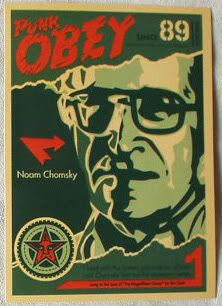
In the documentary Manufacturing Consent (1992), the notion of most media serving the wants of the leading 20% of society is poked at to further understand what Noam Chomsky calls the “propaganda model.” One visual technique that helped immensely was the cinematography playing out as thought processes. Around thirty minutes in when Chomsky is explaining what the “propaganda model” is, he explains it over a series of interviews with different people in one continuous audio track. Additionally, when he brings names and companies into the discussion, just as one recalls that one knows of the subject, it is brought up in a moving image form that shows one the physical buildings in which brands such as the New York Times and CBS operate from. The timing of these shots were crucial and well executed to reestablish the thoughts that a viewer may already have before watching this documentary regarding the media and how large it is. These image cues are extremely helpful by allowing instant identification of these large established companies and they assist viewers into believing the power that these institutions wield. Ironically, this documentary furthers the consent that the masses give to the media by depicting them as powerful corporations that “make the history.” Even though this film sheds some negative light on Chomsky, it still paints him as the intellectual of the 20th century.
Subscribe to:
Posts (Atom)